Adding one later
Adding a battery to an existing solar system
Not a government service. UKSolars is an independent company. It is not affiliated with, endorsed by or acting on behalf of the UK Government, DESNZ, Ofgem, MCS or any local authority. We do not administer any grant scheme, we cannot approve an application, and we never charge for anything a government provides free.
How we are paid. We are paid a fee by installers when we introduce a homeowner who asks for a quote. It does not change your price, and we are not paid more by one installer than another for the same job. In full.
Short answer
Usually. An AC-coupled battery fits alongside your existing solar inverter without replacing it, which is what makes retrofit straightforward even on systems installed years ago. It typically costs £4,000 to £8,000 and pays by moving units from the export rate to the much higher price you avoid paying.
- Typical cost
- £4,000–£8,000
- New inverter needed?
- No, if AC-coupled
- Value of a shifted unit
- About 15p
- Affects FiT?
- Generally no
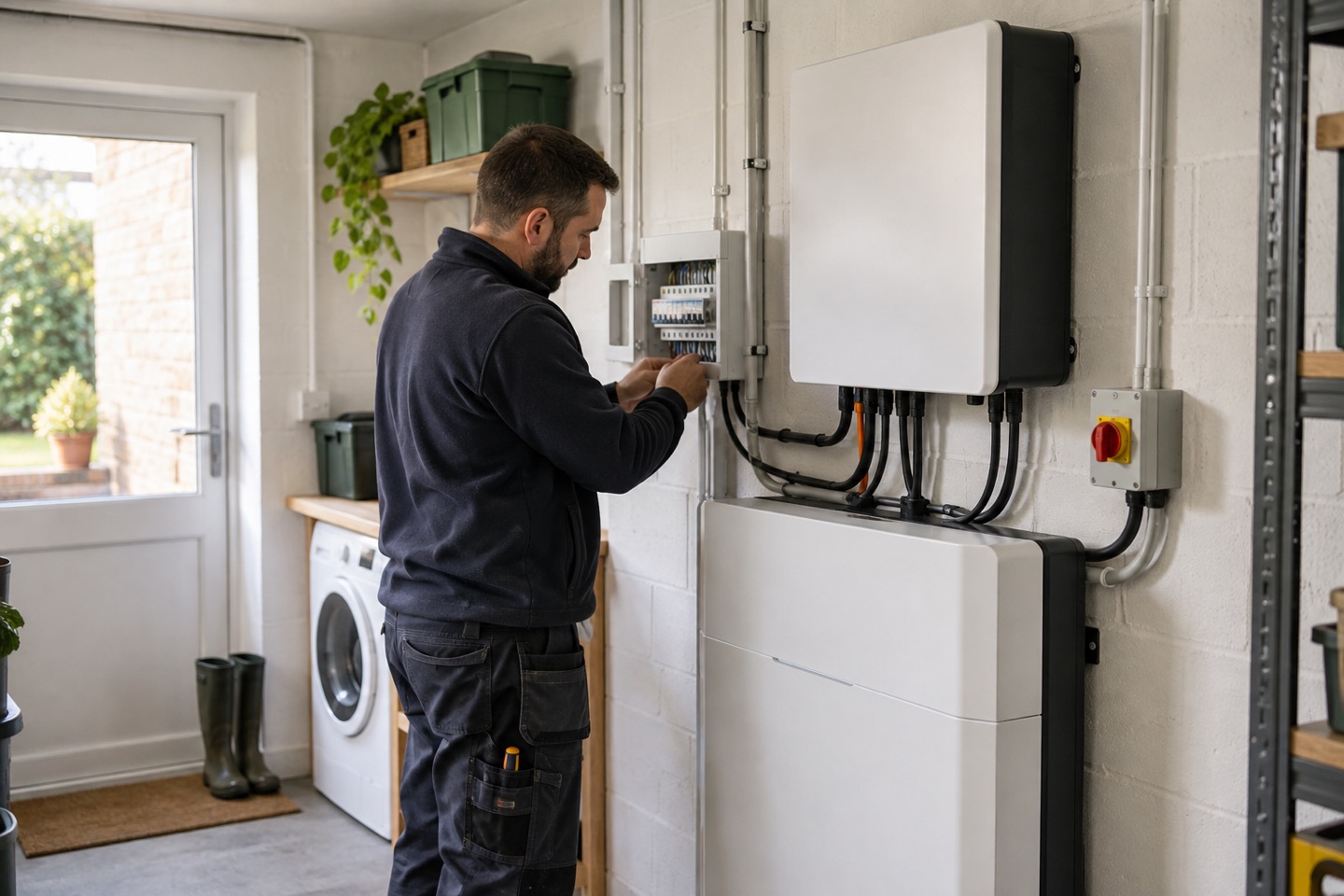
Around two million UK homes already have solar. A large share of them were installed under the Feed-in Tariff between 2011 and 2019, before domestic storage was affordable, and are now exporting most of their midday generation at a fraction of what the household pays to import in the evening.
The panels are already paid for, so the decision is limited to the cost and value of storage.
Yes, you can, and it is simpler than it sounds
An AC-coupled battery has its own inverter and sits alongside your existing solar inverter. Nothing on the roof is touched, the solar system keeps working exactly as it did, and the battery simply watches the house and charges from whatever would otherwise have been exported.
That is what makes retrofit practical on a system installed a decade ago with an inverter that is no longer supported.
The alternative, DC-coupled, connects the battery on the panel side of the inverter and replaces the solar inverter with a hybrid unit. It is slightly more efficient because it avoids one conversion step. It also means new hardware and more labour, and it only makes sense if your existing inverter is near the end of its life anyway, which, at ten to fifteen years, a Feed-in Tariff era inverter may well be.
Ask which one you are being quoted
A quote that replaces your solar inverter is a different job from one that does not. Both are legitimate. The difference in price and disruption is significant enough that it should be stated explicitly rather than discovered on the day.
Where the money comes from
Not from generating more. You will not generate a single extra kilowatt-hour.
The saving is arbitrage between two prices you already face:
~15p
What each unit moved from export to self-consumption is worth: the gap between a typical import price of about 27p and a typical export rate of about 12p
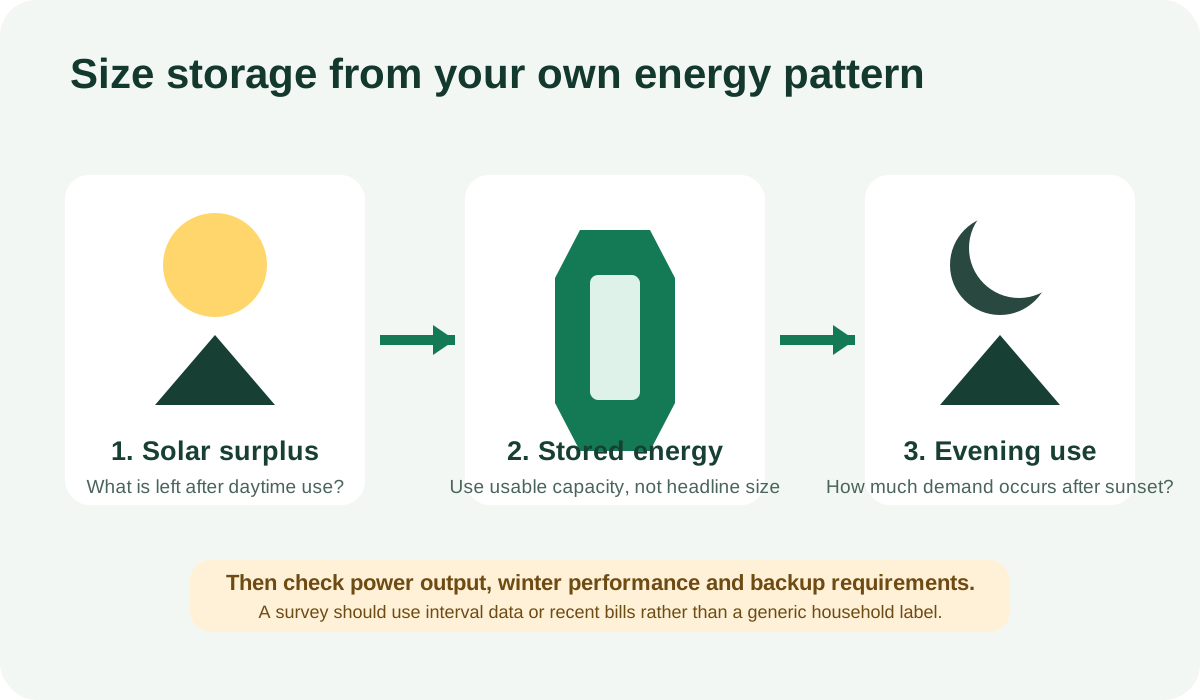
Every unit the battery stores at midday and releases at 7pm is worth that difference. The question is how many units it moves in a year, and that depends on three things: your battery size, evening consumption and available solar surplus.
Check your export rate before you buy a battery
The argument for storage is the gap between import and export prices. If you are on a poor export rate, that gap is wide and a battery looks good, but the cheaper fix might simply be switching to a better export tariff, which costs nothing.
Do that comparison first. Sometimes the answer is a battery. Sometimes it is a phone call.
The Feed-in Tariff question
If your system is on the FiT, two payment streams matter and they behave differently:
- Generation payments are metered at the panels and are unaffected. A battery does not change what you generate.
- Export payments are the ones to check. Many FiT agreements pay for deemed export — an assumed 50% of generation rather than a measured amount. A battery reduces your actual export while the deemed payment continues, which sounds like good news and occasionally triggers a licensee query.
Confirm your position with your FiT licensee before installing. It is a five-minute call and it removes the only real uncertainty in an otherwise straightforward job.
What to expect it to cost
Typically £4,000 to £8,000 installed, driven mainly by usable capacity. Add:
- Scaffolding: usually not needed, since nothing goes on the roof.
- A consumer unit upgrade, where the existing board cannot take the circuit.
- DNO paperwork: a G98 notification, or a G99 application if the combined capacity exceeds 3.68kW per phase, which takes four to eight weeks.
- Space. Batteries want a garage, utility room or loft with a stable temperature. A cold loft is not ideal.
When it does not pay
Being clear about this is more useful than another case for it:
Retrofit usually pays when
- Your array is 4kWp or larger and you are out during weekdays, so most generation is exported.
- Your export rate is poor and your import rate is not.
- You have or plan an EV or a heat pump, which changes the load shape in the battery’s favour.
- You are on a time-of-use import tariff with a wide cheap-to-expensive spread.
It usually does not when
- Someone is home all day and you already self-consume most of what you generate.
- Your array is small: under about 3kWp there is often little surplus to store.
- You have a strong export rate, which narrows the gap the battery earns from.
- You expect to move within a few years. Batteries do not add their cost to a sale price.
What to do next
- Find your current export rate, and check it against the table. Switching may be the cheaper fix.
- Look at a year of half-hourly data if your smart meter offers it: how much you use after sunset is the number that sizes the battery.
- Ask any quote whether it is AC or DC coupled, and whether your solar inverter is being replaced.
- If you are on the Feed-in Tariff, ring your licensee about deemed export before committing.
- Get three quotes. Battery pricing varies more between installers than panel pricing does.
Common questions
Do I need to replace my solar inverter?
Will adding a battery affect my Feed-in Tariff payments?
How much can it save?
Does the 0% VAT rate apply to a retrofit battery?
Do I need DNO approval again?
Sources
- Ofgem: Smart Export Guarantee
- Ofgem: Feed-in Tariff scheme
- Energy Networks Association: connecting generation to the electricity networks
- HMRC: VAT Notice 708/6
Checked 2026-09-02. Rates, rules and eligibility can change. Confirm current terms before signing a contract or applying for funding.
Work out the number before anyone quotes you
Every assumption editable, nothing sent anywhere, no email. It will not give you a quote, but it will tell you whether one is fair.
We are not taking quote requests yet
We will not collect your details until we can name the installers who would receive them, so there is no form here to fill in. What we can do is tell you when something changes: a scheme opening, an export rate moving, or the quote form going live.