Claims to be careful with
"Free solar panels": what is really on offer
Not a government service. UKSolars is an independent company. It is not affiliated with, endorsed by or acting on behalf of the UK Government, DESNZ, Ofgem, MCS or any local authority. We do not administer any grant scheme, we cannot approve an application, and we never charge for anything a government provides free.
How we are paid. We are paid a fee by installers when we introduce a homeowner who asks for a quote. It does not change your price, and we are not paid more by one installer than another for the same job. In full.
Short answer
Fully funded solar exists in the UK but is narrow: a low-income household in an EPC D to G property, funded under ECO4 or Warm Homes: Local Grant, usually alongside insulation or a heating measure rather than on its own. Most people searching this phrase will not qualify, and should be told so rather than sold to.
- Fully funded?
- For a narrow group
- Ways to qualify
- Three, under WH:LG
- EPC needed
- D to G
- Solar alone?
- Rarely
Fully funded solar exists, but most households will not qualify. Here is who may qualify and what other “free solar” offers involve.
Who may get fully funded solar
Two schemes, and the routes into them are not identical.
ECO4 reaches households on a qualifying means-tested benefit — Universal Credit, Pension Credit, income-based JSA or ESA, Income Support, certain tax credits, or referred by a council under LA Flex, which can qualify households in fuel poverty or living with a health condition made worse by a cold home. It closes on 31 December 2026.
Warm Homes: Local Grant covers privately owned homes in England rated EPC D to G, and has three income routes: you need only one:
| Route | What it means | | --- | --- | | IMD income deciles 1–2 | Your area is among the most income-deprived. No income check at all. | | Low-income proxies | Qualifying benefits and similar indicators. | | Income threshold | Gross household income of £36,000 or less. |
The first is the one people miss, and it is the reason to check your postcode before you conclude you earn too much.
Solar is not guaranteed
Both schemes work on a whole-house basis. The property is assessed and modelled, and funding goes to whatever improves it most, which in a poorly insulated home is insulation, and in a home with failing heating is the heating.
Solar gets attached where the modelling supports it. It is not something you request, and for many qualifying households the funded package contains no solar at all.
The schemes are real, but eligibility is narrow and the funded package may not include solar.
The other three things called “free solar”
1. Rent a roof
A company installs panels at no cost to you and keeps the export income, in exchange for a lease over your roof, typically 20 to 25 years.
The panels really are free. The roof rights are the price, and they outlast most people’s plans. A long roof lease can complicate a remortgage or a sale, and some lenders will not lend against one without the lease being varied. That is a decision to take to a solicitor, not to a doorstep.
2. The doorstep version
Unsolicited contact, an offer framed as free or as a scheme you have been “selected” for, and pressure to sign today. What is usually being sold is a finance agreement, and the “free” part is either the survey or a discount that was never real.
The rules are simple and they work: never sign on the day, never pay a deposit for something described as free, and check the company on the MCS register under the exact name on the paperwork. The full list of warning signs.
3. “Free” meaning zero upfront
A finance agreement with nothing to pay on day one. That is not free, it is credit, and the total cost over the term is the number that matters.
We do not introduce anyone to a lender: that is a regulated activity we are not authorised for. So we have no interest in whether you take finance. We do have an interest in the word being used accurately.
If you do not qualify: what everyone gets
Two things apply regardless of income:
- 0% VAT on domestic installations until 31 March 2027, after which it reverts to 5%. Nothing to apply for; a compliant installer zero-rates the invoice.
- The Smart Export Guarantee, which pays you for every unit you export. The rate varies enormously between suppliers and the best headline numbers are usually tied to taking your import supply from the same company.
Neither makes solar free. Both are real, and both apply to the large majority of people who arrive at this page.
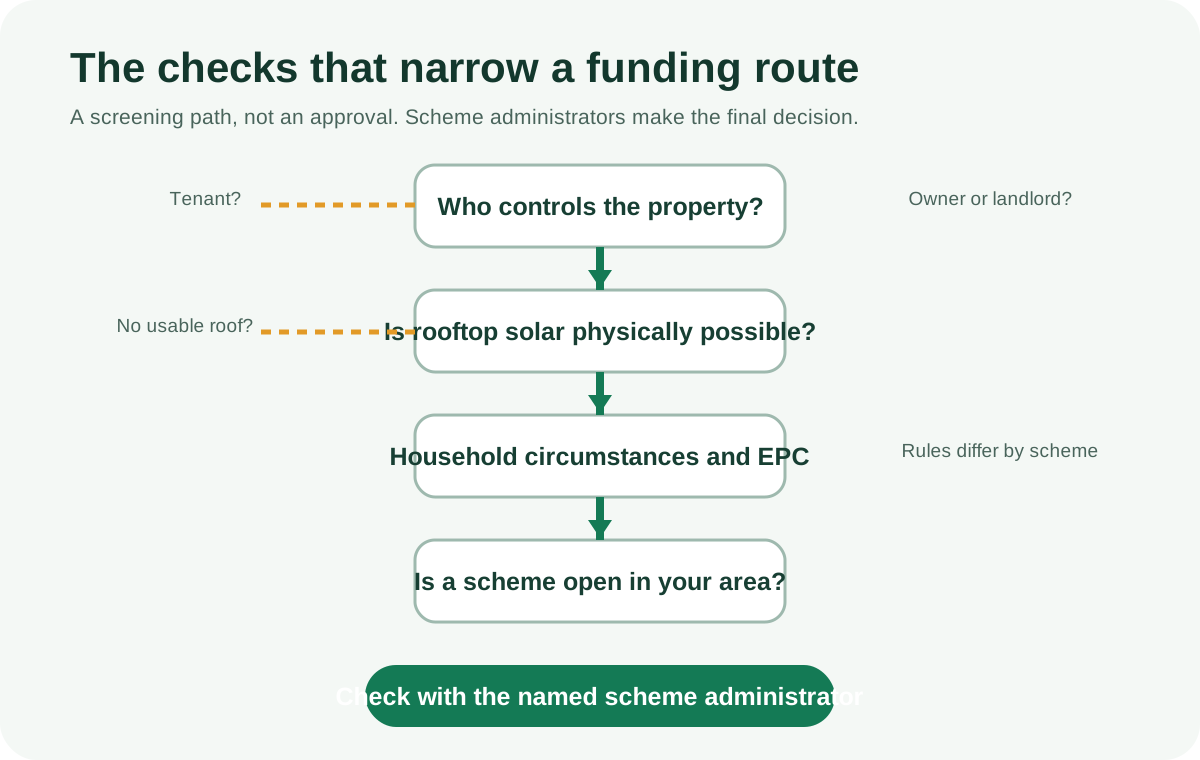
The three questions that settle it
- Do you meet any one of the three income routes: IMD deciles 1–2, a qualifying benefit, or under £36,000?
- Is your EPC rating D to G? Look it up free on the government register.
- Is the home privately owned: by you, or by a landlord willing to be the applicant?
Three yeses and it is worth pursuing. Otherwise the funded route may not be open to you. The eligibility checker will tell you on screen, without asking for your email first.
Common questions
Is there a government scheme giving away free solar panels?
Are free solar panels a scam?
What about "rent a roof" offers?
Are there free solar panels for pensioners?
I do not qualify. Is there anything for me?
Sources
- Ofgem: Energy Company Obligation (ECO4)
- gov.uk: Apply for the Warm Homes: Local Grant
- CAP Code: Section 3: Misleading advertising, including free claims
Checked 2026-09-02. Rates, rules and eligibility can change. Confirm current terms before signing a contract or applying for funding.
Check whether you qualify
Answer six questions and see the result on screen. No email required.
Get grant updates
We will email you when a scheme, threshold or deadline changes.