The rules
G98 notification for a plug-in kit
Not a government service. UKSolars is an independent company. It is not affiliated with, endorsed by or acting on behalf of the UK Government, DESNZ, Ofgem, MCS or any local authority. We do not administer any grant scheme, we cannot approve an application, and we never charge for anything a government provides free.
How we are paid. We are paid a fee by installers when we introduce a homeowner who asks for a quote. It does not change your price, and we are not paid more by one installer than another for the same job. In full.
Short answer
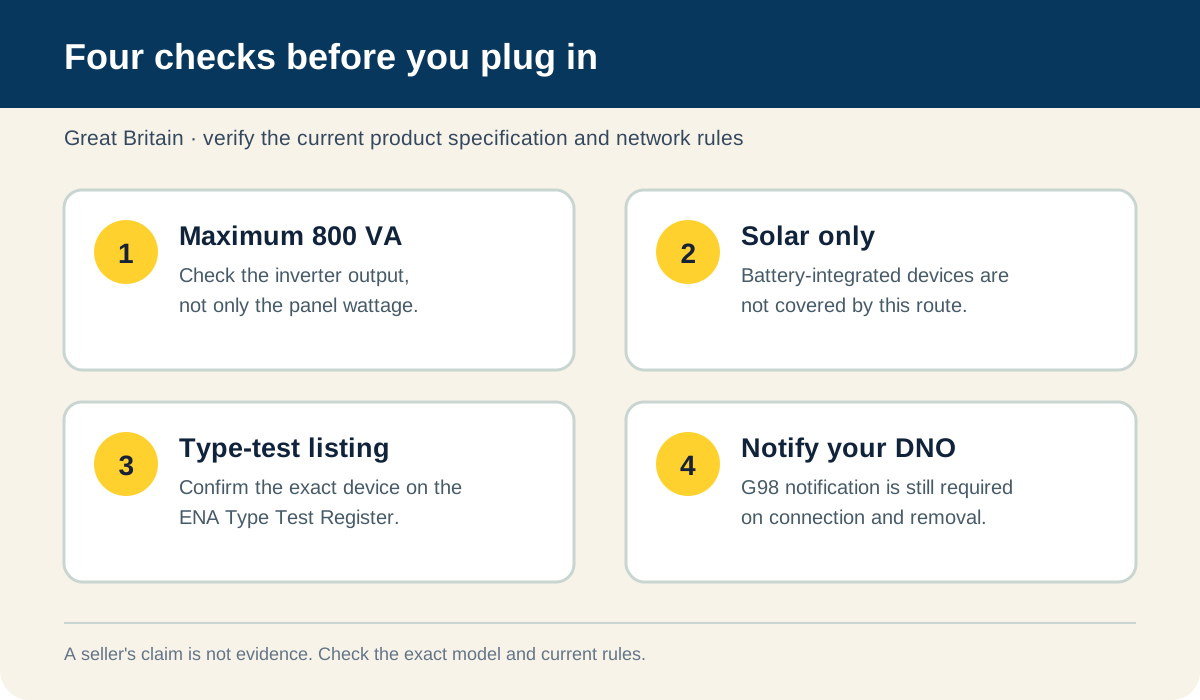
G98 notification to your distribution network operator is still required for a plug-in kit, on connection and again on disconnection. It is a notification rather than an application, so a compliant installation at or below 16A per phase does not normally wait for connection approval. The ENA's standard process gives the installer 28 days after commissioning to notify the DNO; follow the device instructions and your DNO's stated route.
- Approval needed?
- No: notify only
- Fee
- None
- Also notify on
- Disconnection
- Threshold
- 16A per phase
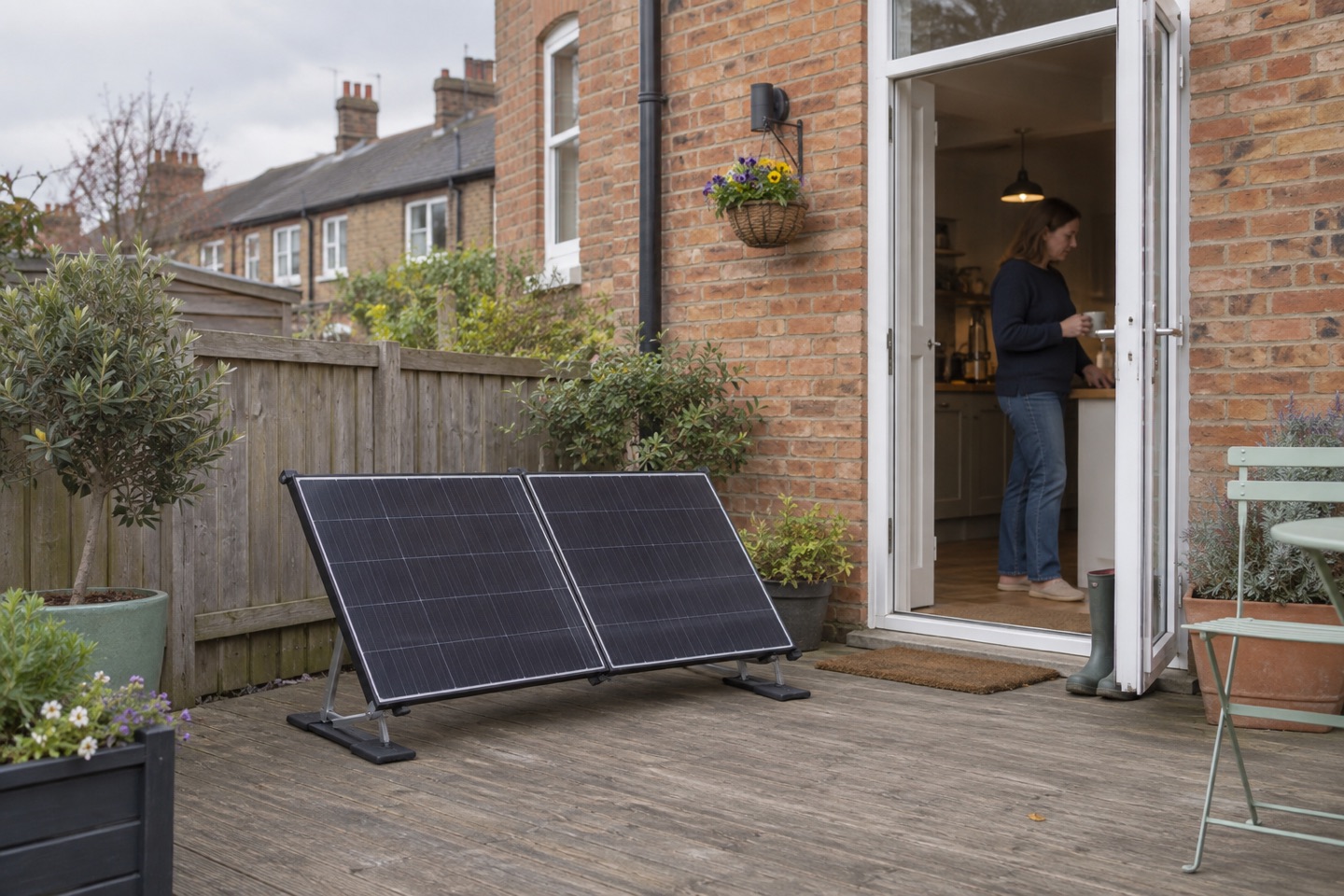
This is the step people skip, because a plug-in kit feels like an appliance rather than an installation. It plugs into a socket; nothing is drilled; no electrician appears.
But the kit is generating electricity and pushing it into a public distribution network, and the operator of that network is entitled to know what is connected to it. That is what G98 is for.
Notification, not application
The distinction matters and it is good news.
G98 covers generation up to 16A per phase at low voltage: commonly stated as 3.68kW at 230V. For the standard single-premises route, the ENA says the installer can commission first and must notify the DNO within 28 days. There is no connection approval to wait for when the installation stays within that route.
G99 covers anything above that. There you must obtain approval before installation, and it can come back with conditions. This is why a larger roof array is a slower process than a plug-in kit, and one of the reasons installers ask about your existing generation.
An 800 VA plug-in kit sits comfortably inside G98.
Your DNO is not your supplier
Your DNO is not your supplier
Your supplier is who you pay for electricity, and you can change them whenever you like. Your distribution network operator owns the cables in your street and is fixed by geography. Switching supplier does not change your DNO.
There are six DNO groups in Great Britain, plus NIE Networks in Northern Ireland:
| Operator | Broadly covers | | --- | --- | | UK Power Networks | London, the South East, the East of England | | National Grid Electricity Distribution | The Midlands, the South West, South Wales | | Northern Powergrid | The North East, Yorkshire, northern Lincolnshire | | Electricity North West | The North West | | SP Energy Networks | Merseyside, North Wales, central and southern Scotland | | Scottish and Southern Electricity Networks | Southern England, northern Scotland | | NIE Networks | Northern Ireland |
If you are not sure which applies, the first two digits of your MPAN: the long number on your electricity bill: identify the distributor, and your supplier’s customer service can confirm it in a minute.
What the form asks for
Very little:
- Your MPAN, from your electricity bill.
- The installation address.
- The inverter make and model.
- Its rated AC output: the 800 VA figure.
- The date it was connected.
The exact evidence and submission route depend on the DNO and equipment. ENA Connect Direct provides a common route for installers, while some DNOs publish their own forms. Do not assume the retail checkout completed the notification: keep the DNO or ENA confirmation.
Tell them when you disconnect, too
This is the half that gets forgotten. The product specification requires plug-in solar devices to carry a statement that notification to the DNO about connection and disconnection is mandatory. So if you take the kit with you when you move, or stop using it, the operator needs to know that as well.
Northern Ireland
SI 2026/848 applies to Great Britain. Northern Ireland has its own regulatory framework and NIE Networks handles connections there, so do not assume the GB position transfers. Ask NIE Networks directly before connecting anything.
Check whether guidance applies to Great Britain or the whole United Kingdom.
The process, step by step
Find out who your network operator is
Your DNO is not your electricity supplier. It is determined by geography, and there are six in Great Britain plus NIE Networks in Northern Ireland. Your supplier's customer service can tell you, or the first two digits of your MPAN identify it.
Gather the details
Your MPAN (on your electricity bill), your address, the inverter make and model, its rated AC output, and the installation date. That is all a G98 notification asks for.
Submit the notification
For standard G98 installations, the installer must notify the DNO within 28 days of commissioning. Plug-in products must also tell the purchaser that connection and disconnection notification is mandatory. Use the route named by your DNO or ask the product supplier to identify it.
Keep the confirmation
Save the reference. It is what you will want if there is ever a query about the connection, and a future buyer's solicitor may ask for it.
Common questions
What happens if I do not notify?
Is my DNO the same as my electricity supplier?
What is the 3.68kW figure I keep seeing?
Do I need to notify again if I move the kit?
Sources
- Energy Networks Association: connecting generation to the electricity networks
- Energy Networks Association: G98 single-premises summary guide
- Energy Networks Association: Connect Direct
- DESNZ: Plug-in Solar Device Interim Product Specification v2.0 (July 2026)
Checked 2026-09-02. Rates, rules and eligibility can change. Confirm current terms before signing a contract or applying for funding.