What replaces them
The Warm Homes Plan
Not a government service. UKSolars is an independent company. It is not affiliated with, endorsed by or acting on behalf of the UK Government, DESNZ, Ofgem, MCS or any local authority. We do not administer any grant scheme, we cannot approve an application, and we never charge for anything a government provides free.
How we are paid. We are paid a fee by installers when we introduce a homeowner who asks for a quote. It does not change your price, and we are not paid more by one installer than another for the same job. In full.
Short answer
The Warm Homes Plan was published on 21 January 2026: £15bn to upgrade up to 5 million homes and lift up to 1 million households out of fuel poverty by 2030. It is already delivering through the Warm Homes Social Housing Fund and Warm Homes: Local Grant, which are to be integrated into a single low-income scheme from 2027/28.
- Published
- 21 January 2026
- Committed
- £15bn
- Target
- Up to 5m homes by 2030
- Status
- Already delivering

The plan is already running
The Warm Homes Plan is not a future scheme waiting to open in January 2027. A great deal of content says so, and we said it ourselves until we read the source.
DESNZ’s own document describes delivery happening now, through the Warm Homes Social Housing Fund and Warm Homes: Local Grant, with those two integrated into a single low-income capital scheme from 2027/28 onwards. If you qualify, the thing to do is apply: not wait.
What the plan funds
Published 21 January 2026:
- £15bn of public investment.
- Upgrades to up to 5 million homes by 2030.
- Lifting up to 1 million households out of fuel poverty by 2030.
- Around £5bn for low-income and fuel-poor households to 2030, of which £4.4bn is direct capital grants.
- An initial £600m from the Warm Homes Fund.
The official plan also allocates £4.422bn to low-income capital grants and describes a £5.3bn Warm Homes Fund across its financing measures. These programme totals are not the amount an individual household can claim.
Consumer loans
Every means-tested UK energy scheme before this one could only ever help households on qualifying benefits, which is most emphatically not most households. The Warm Homes Fund is the first serious attempt at the rest.
£1.7bn
Committed to new low- and zero-interest consumer loans, with a further £300m to lower the cost of those loans
The loans explicitly cover solar panels and batteries, on the reasoning that those “facilitate immediate electricity bill savings”, which is the right reasoning, because a loan against a measure that starts saving money immediately is a very different proposition from one against insulation that pays back slowly.
It is rolling out in phases, expanding over time, and fuller eligibility detail is still to be published. Funding is committed, but the full household application route is not yet available.
Solar specifically
Solar is not an afterthought in this Plan, which is a change from ECO4:
- Low-income grant support covers “solar PV, batteries, cost effective insulation”.
- The consumer loans cover “solar panels and batteries”.
- New-build standards require “solar panels by default”: see the new-build solar requirements.
- The Plan sets an ambition of up to 3 million more homes with solar by 2030.
That last figure is worth holding onto. There are roughly 2 million UK solar installations today, so the ambition is to more than double the installed base inside four years.
What this means for you, by situation
Act now
- You are on a means-tested benefit or a low income with an EPC of D to G: Warm Homes: Local Grant is live and council-run.
- You qualify for ECO4: it closes 31 December 2026 and the real deadline is earlier.
- You are buying anyway: the 0% VAT rate runs to 31 March 2027 and needs no application.
Watch and wait
- You are above the means-tested thresholds and want help with upfront cost: the Warm Homes Fund loans are aimed at you, and the detail is still coming.
- You want to know your exact grant amount: grant levels per household are not published.
- You are in Scotland, Wales or Northern Ireland: delivery is devolved and your route differs.
Why the naming causes so much confusion
Three different things share a name, and a lot of content treats them as one:
| Name | What it is | Status | | --- | --- | --- | | Warm Homes Plan | The £15bn programme overall | Published Jan 2026, delivering now | | Warm Homes: Local Grant | Council-run grants for low-income private homes | Live, England | | Warm Homes: Social Housing Fund | The social-landlord equivalent | Live | | Warm Homes Fund | The financing arm: the consumer loans | Phasing in |
If a page uses “Warm Homes Plan” and “Warm Homes: Local Grant” interchangeably, it has not read the source. They are a programme and one of its delivery schemes.
What we will do when this changes
Every figure above is tied to a DESNZ publication in the sources below, and the funding tracker carries a dated changelog. When the loan terms or the per-household grant levels are published, that entry will say what changed, on what date, and which document says so.
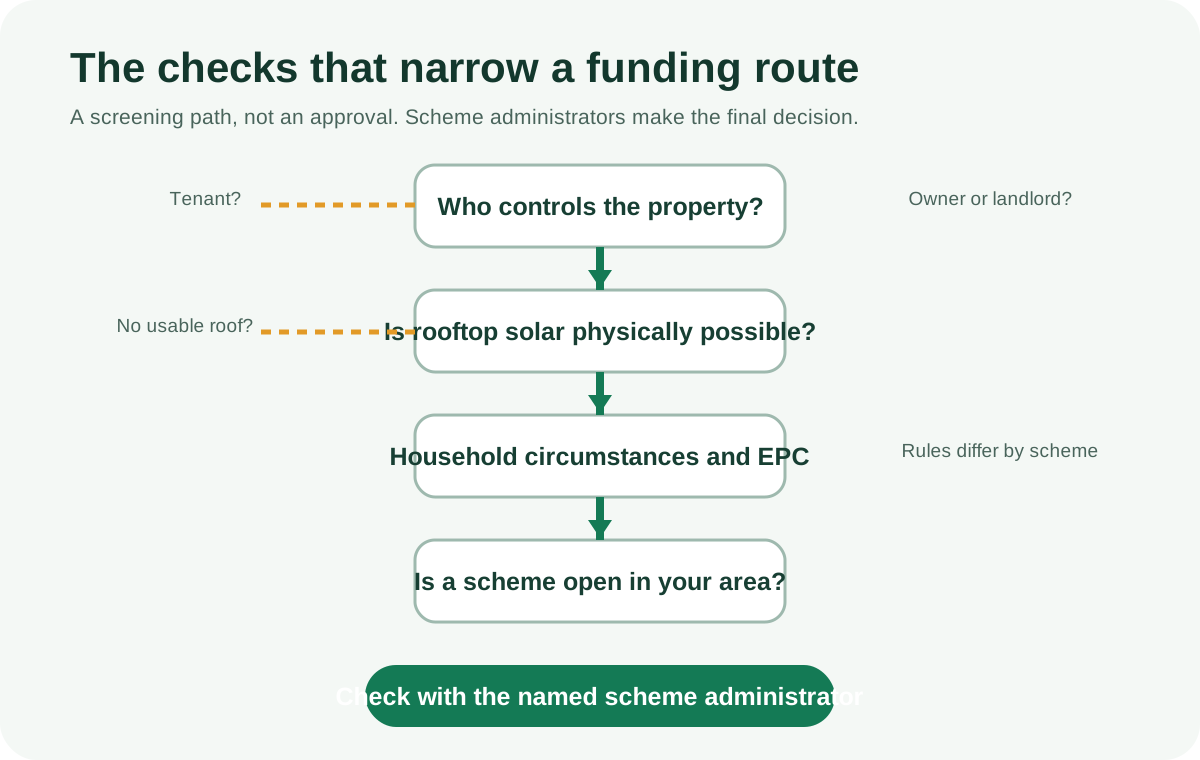
Common questions
When does the Warm Homes Plan start?
Does the Warm Homes Plan pay for solar panels?
Do I have to be on a low income?
Should I wait rather than applying to ECO4?
What is the Warm Homes Fund?
Sources
- DESNZ: Warm Homes Plan (published 21 January 2026)
- DESNZ: Warm Homes Plan: technical annex
- gov.uk: Apply for the Warm Homes: Local Grant
Checked 2026-09-11. Rates, rules and eligibility can change. Confirm current terms before signing a contract or applying for funding.
Check whether you qualify
Answer six questions and see the result on screen. No email required.
Get grant updates
We will email you when a scheme, threshold or deadline changes.