The rules
The plug-in solar rules, in detail
Not a government service. UKSolars is an independent company. It is not affiliated with, endorsed by or acting on behalf of the UK Government, DESNZ, Ofgem, MCS or any local authority. We do not administer any grant scheme, we cannot approve an application, and we never charge for anything a government provides free.
How we are paid. We are paid a fee by installers when we introduce a homeowner who asks for a quote. It does not change your price, and we are not paid more by one installer than another for the same job. In full.
Short answer
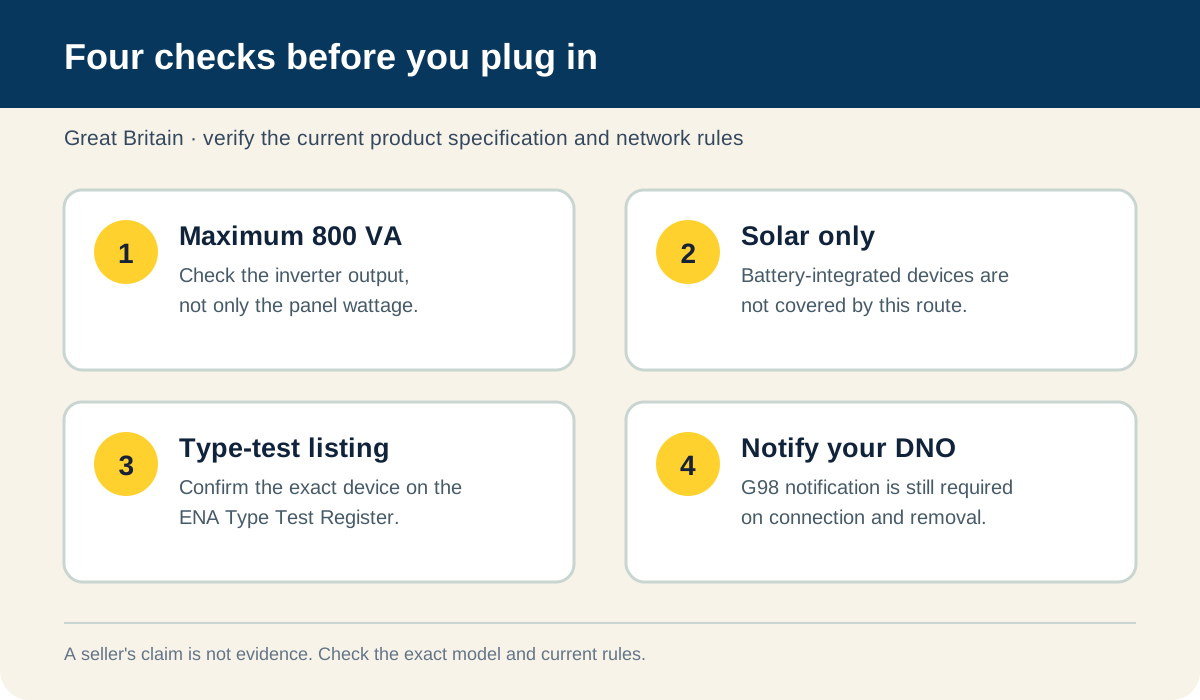
The cap is 800 VA apparent power and 3.5 A, measured at the inverter, but the panels may total up to 2,000 W DC. Battery systems are out of scope. Devices must be type tested to G98 and listed on the ENA Type Test Register before sale. And several household circuits are off limits, including lighting circuits.
- AC output
- 800 VA max
- Current
- 3.5 A max
- PV modules
- 2,000 W DC max
- Compliance
- ENA Type Test Register
The regulation is short; the specification behind it is 45 pages. Most of the confusion comes from four details that are easy to state and easy to get wrong, plus a set of installation rules that barely anyone has reported.
This page works from Version 2.0, July 2026 of the DESNZ Interim Product Specification.
1. The cap is 800 VA, and the panels can be bigger
The specification requires that “the maximum apparent power Smax supplied to the mains installation does not exceed 800 VA and the maximum current does not exceed 3.5 A”.
Then, separately:
2,000 W
The maximum permissible sum of PV module DC power output, against an 800 VA AC output cap
DESNZ: Plug-in Solar Device Interim Product Specification v2.0, §4.1
So a compliant kit may carry up to 2,000 W of panels behind an inverter capped at 800 VA. That is not a loophole; it is deliberate, and it is the single most useful thing to know when comparing kits. More panel capacity means more generation in exactly the low, diffuse light that makes up most of a British year.
Anyone telling you the panel total must stay under 800 W has misread the specification.
2. Batteries are outside the scope
The specification states it “does not apply to other technologies including but not limited to” a list that includes plug-in battery systems and plug-in solar PV devices integrated with battery systems.
And in the documentation requirements: instructions “shall include a prominent warning that the plug-in solar device is not intended to be connected to, operated with, or used in conjunction with a battery energy storage system”.
The question to ask
“Does this kit contain, or work with, any energy storage?”
A yes puts the product outside the specification, whatever the listing says about being legal from 27 August. A good deal of what is most visible in UK retail is battery-integrated.
3. Compliance runs through the ENA Type Test Register
This is where most published guidance: including our own first version of this page: got it wrong by describing a “whole-kit certification”.
The specification requires:
- Manufacturers type test the device in accordance with G98 requirements.
- They register the device on the ENA Type Test Register via the ENA Direct Connect platform, and obtain confirmation it has been assessed as compliant, before placing it on the market.
- A device merely submitted for registration “shall not, in itself, be regarded as demonstrating compliance”.
- They retain a technical file: test reports, structural loading calculations, conformity with referenced standards: for at least 10 years after last manufacture.
So there is no consumer-facing certificate. There is a register, and a device is either on it or it is not. That is a better check than a certificate anyway, because you can verify it without taking the seller’s word.
Kits do not have to arrive in one piece
The specification recognises three device types, and all are legitimate:
| Type | What it is | | --- | --- | | One-component | A single PV module with an integrated inverter; DC connections already made | | Two-component | Supplied as a kit of a module and an inverter; the user makes the DC connections per the instructions | | Multi-component | A kit of one or more modules and an inverter |
The requirement attaches to the device as supplied, not to whether it is sealed.
4. One per household, for now
Two rules, and the stricter binds:
- The specification permits one plug-in solar product per household final ring circuit, “to ensure the currents flowing through the electrical connection to the consumer unit remain within safe levels”.
- G98 Issue 2 Amendment 1 2026 restricts this to one device per household, and the specification notes this “applies unless and until that is amended”.
5. Installation rules
These come from the specification’s documentation requirements, and they are the practical ones: the difference between a safe install and a fire.
- No extension cables, multi-way adaptors or RCD adaptors. The device plugs into a fixed socket, directly.
- Not on a lighting circuit. Explicitly not permitted.
- Not on a spur circuit supplying fixed equipment such as an electric cooker or a boiler. Explicitly not permitted.
- The circuit needs RCBO protection and to be in good condition. Older installations using fuse protection without RCBOs should be checked and, where necessary, upgraded by a professional electrician.
- Identify which sockets share a circuit before you install: they are the ones that switch off together. If you are unsure how to check safely, get advice.
- Any work modifying the final circuit, such as changing the overcurrent protection device, is a job for a qualified electrician.
If you live in a flat, read the fire-safety point
The specification requires instructions to address resisting fire spread from one dwelling to another, proportionate to the panel’s size, use and position, and it references restrictions relating to external wall fire safety and remediation works.
If your building is subject to cladding or external wall fire safety restrictions, that is a question to settle with the freeholder or managing agent before you buy, not after.
6. Great Britain only
Engineering Recommendation G98 applies to Great Britain. Northern Ireland’s connection requirements are set separately, so the position there does not automatically follow.
Check whether other solar guidance applies to Great Britain or the whole United Kingdom.
The underlying safety evidence
For what it is worth, this was not waved through. DESNZ commissioned a study — Plug-in PV Systems in the United Kingdom: Electrical Safety, Compatibility and Implementation Considerations: into the behaviour of these products on UK ring final circuits. It concluded that plug-in solar products already used in Germany and elsewhere are safe on UK circuits under defined limits and conditions, and the specification exists to define exactly those limits.
The specification is also explicitly interim: it says it “may be modified from time to time or superseded” as British Standards specific to plug-in solar are developed. We will date any change on the funding tracker changelog.
Common questions
Can I fit 1,200 W of panels behind an 800 VA inverter?
Does the kit have to be a single sealed unit?
Which sockets can I use?
Why are batteries excluded?
Is there a limit on how many I can have?
Sources
- DESNZ: Plug-in Solar Device Interim Product Specification v2.0 (July 2026)
- legislation.gov.uk: SI 2026/848
- DESNZ: Plug-in solar: regulatory amendment and interim product specification
Checked 2026-09-11. Rates, rules and eligibility can change. Confirm current terms before signing a contract or applying for funding.