The rules
Is plug-in solar legal in the UK?
Not a government service. UKSolars is an independent company. It is not affiliated with, endorsed by or acting on behalf of the UK Government, DESNZ, Ofgem, MCS or any local authority. We do not administer any grant scheme, we cannot approve an application, and we never charge for anything a government provides free.
How we are paid. We are paid a fee by installers when we introduce a homeowner who asks for a quote. It does not change your price, and we are not paid more by one installer than another for the same job. In full.
Short answer
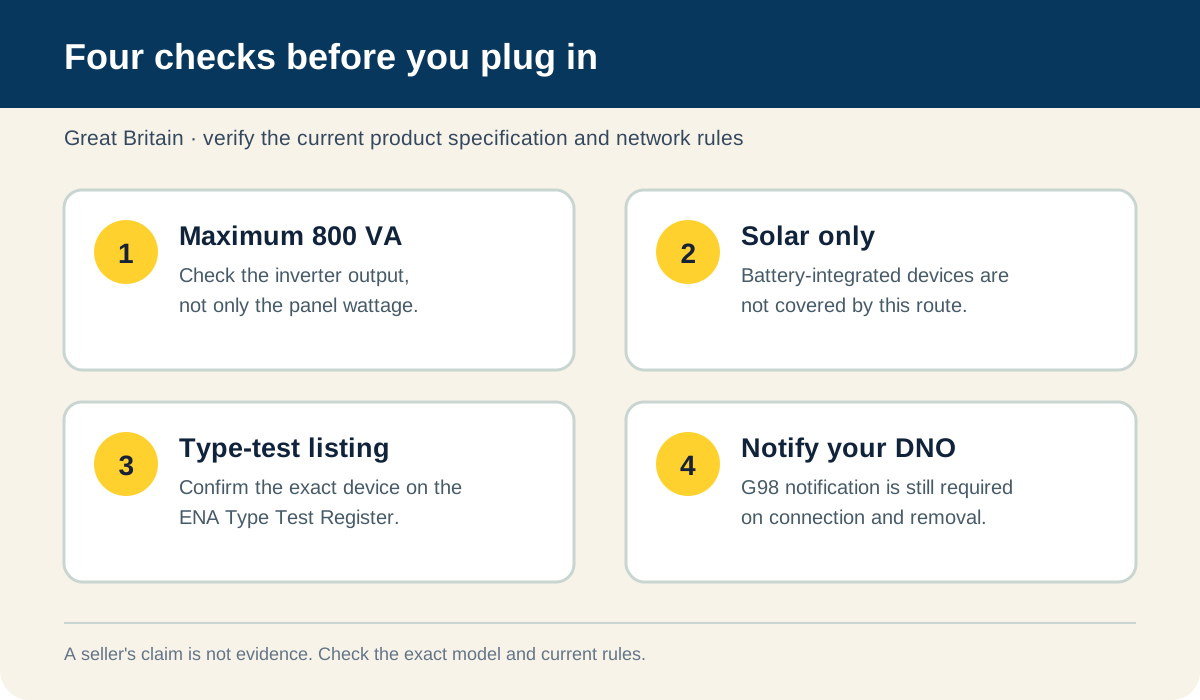
In Great Britain, yes: from 27 August 2026 under SI 2026/848. Four conditions apply: a maximum of 800 VA apparent power, solar only with battery systems excluded, the device must be type tested and listed on the ENA Type Test Register before sale, and you must notify your network operator under G98.
- Legal from
- 27 August 2026
- Output cap
- 800 VA / 3.5 A
- Panel cap
- 2,000 W DC
- Batteries
- Out of scope
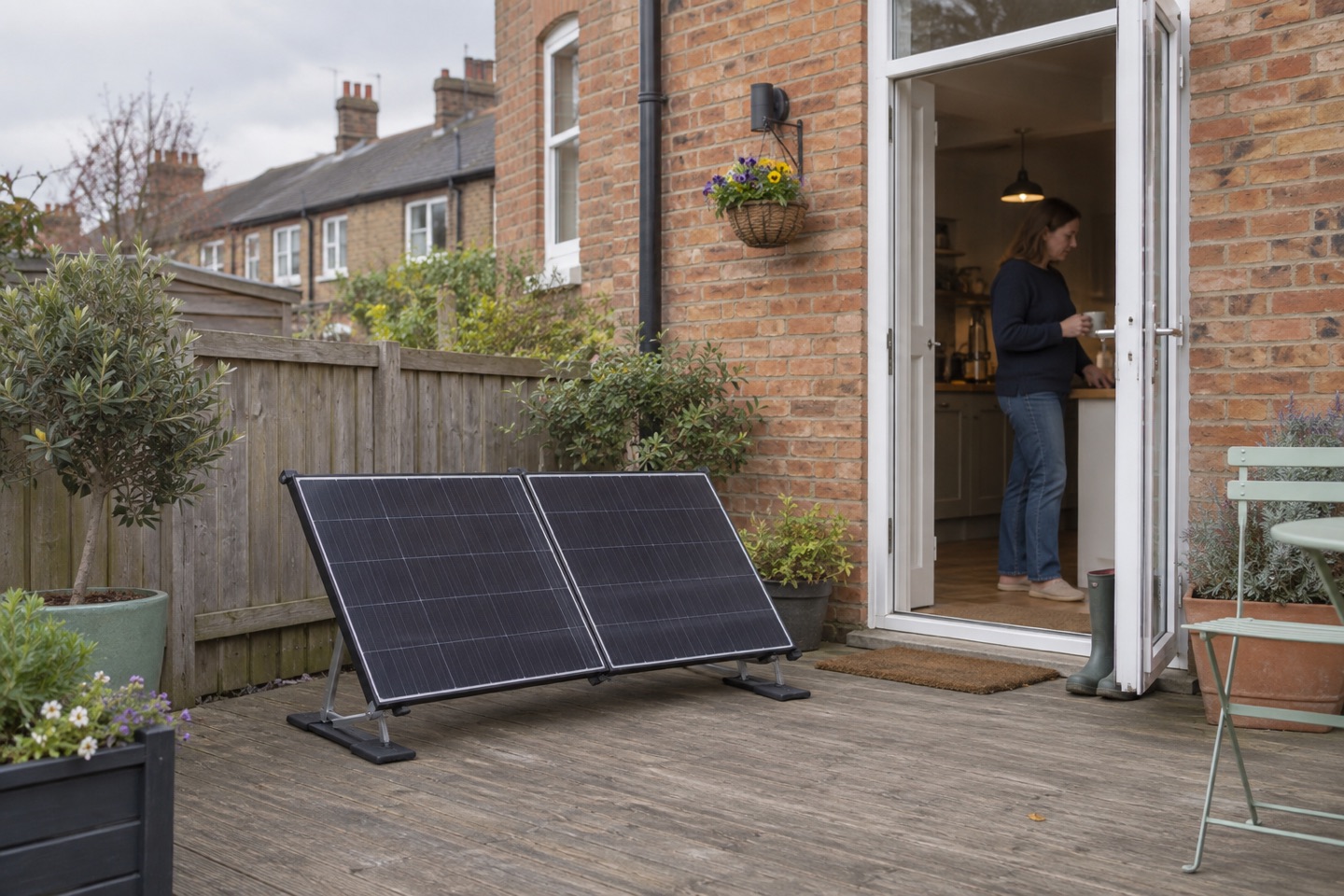
Plug-in solar: a small panel array with a built-in inverter that plugs into an ordinary socket, sold across Europe for years as Balkonkraftwerk: was not lawful to connect in Great Britain until 27 August 2026.
SI 2026/848 was made on 16 July 2026 and came into force on 27 August 2026. The change is real. It is also narrower and more specific than most of the coverage suggests, and the gap between “plug-in solar is now legal” and “this kit is legal” is where people are going to lose money.
The four conditions
All four, or the kit is not covered
These are cumulative, not alternatives. A kit satisfying three of them is outside the specification as completely as one satisfying none.
1. 800 VA, and 3.5 A
The specification sets a maximum apparent power of 800 VA supplied to the mains installation, and a maximum current of 3.5 A. Nearly everything written about this says “800W”; the real figure is 800 VA of apparent power, measured at the inverter output.
The distinction matters less for shopping than for understanding what the inverter must be rated at, but if a seller quotes a figure above 800 VA, that is disqualifying.
2. You may fit up to 2,000 W of panels
This allows the panels to exceed the inverter rating while export remains capped.
The specification caps PV module DC power output at 2,000 W, against an 800 VA AC output. So a compliant kit can carry substantially more panel capacity than its inverter can deliver at once, and in UK conditions that is a better design, not a compromise. Panels rarely reach their rated output here, so an oversized array lifts generation through the dull, diffuse light that dominates the British year, while the inverter simply clips on the few brightest days.
If a seller tells you the panels must total under 800 W, they have misread the rule.
3. Solar only: batteries are out of scope
The specification says plainly that it does not apply to, among other things, “plug-in battery systems” and “plug-in solar PV devices integrated with battery systems”.
It goes further: instructions must carry a prominent warning that the device is not intended to be connected to, operated with, or used in conjunction with a battery energy storage system.
That rules out a meaningful share of what is most visible in UK retail: the all-in-one units pairing a small array with a few kWh of storage. Legalising plug-in solar did not legalise those.
4. It must be on the ENA Type Test Register
Check the public register before buying.
Manufacturers must type test the device to G98 requirements, register it on the ENA Type Test Register (through the ENA Direct Connect platform), and obtain confirmation that it has been assessed as compliant before placing it on the market. The specification adds that a device merely submitted for registration is not thereby compliant.
What to ask a seller
“Is this device listed on the ENA Type Test Register?”
That is a verifiable question with a checkable answer, which is much better than asking for a certificate you cannot interpret. Note that compliance rests on manufacturer type testing and a retained technical file plus that registration: there is no third-party “kit certificate” to wave at you, so anyone offering one is describing something that does not exist.
Plus: notify your network operator
Legalisation did not remove the obligation. G98 notification to your distribution network operator is required, and the specification requires the product to carry a statement that notification about connection and disconnection is mandatory.
How to notify, and who to notify: about ten minutes, free, and no approval to wait for.
One device per household, for now
Here the specification and the grid code differ, and the stricter one wins:
- The product specification permits one plug-in solar product per household final ring circuit, so that current through the connection to the consumer unit stays within safe levels.
- G98 Issue 2 Amendment 1 2026 currently restricts this to one device per household, and that applies unless and until G98 is amended.
So: one, today. The specification anticipates that changing, but “expected to change” is not a basis for connecting a second one.
What you are buying
An 800 VA kit in a reasonable position generates in the region of 650 to 800 kWh a year, and only the part you consume as it is generated is worth anything to you, because plug-in kits are not metered for export.
That is not nothing. It is also not solar in the sense most people mean: a conventional 4kWp roof array produces 3,400 to 4,200 kWh a year, roughly five times as much.
Plug-in solar is the right answer when
- You rent, and cannot make structural changes.
- You live in a flat with a balcony and no roof rights.
- You want to try solar without a five-figure decision.
- Your usable outdoor space is a wall, a fence or a railing rather than a roof.
It is the wrong answer when
- You own a house with a usable roof: the output difference is roughly five to one.
- You are hoping to be paid for export. Plug-in kits are not metered for it.
- You expect it to make a visible difference to a heat pump or an EV. It will not.
- The kit contains a battery, in which case the specification does not cover it at all.
What to check before you pay
- The device is listed on the ENA Type Test Register. Ask, and check.
- Inverter output is 800 VA or less, maximum current 3.5 A.
- The kit contains no battery, and is not designed to work with one.
- Total PV module DC output is 2,000 W or less: more panels than inverter is fine, and good.
- Your consumer unit has RCBO protection and is in good condition.
- The mounting is rated for the surface and for wind loading at the height you intend.
- You know which network operator covers your postcode, and you notify them.
Where this sits in the market
There is a reasonable argument that plug-in solar matters more as a signal than as a technology: it is the first time Great Britain has allowed anyone to generate their own electricity without an installer, a survey and a five-figure contract. For renters and flat-dwellers: a third of UK households, and a group every other page on this subject quietly ignores: it is the only option that has ever existed.
If you own a suitable roof, compare it with plug-in against a real installation, and the numbers are not close.
Common questions
Is plug-in solar legal in Northern Ireland?
Can I install two kits?
Is the limit 800 watts or 800 VA?
What if my kit has a battery in it?
How do I check a kit is compliant?
Do I need an electrician?
Sources
- legislation.gov.uk: SI 2026/848: The Plugs and Sockets etc. (Safety) Regulations 1994 and Electricity Safety, Quality and Continuity Regulations 2002 (Amendment) Regulations 2026
- DESNZ: Plug-in Solar Device Interim Product Specification v2.0 (July 2026)
- DESNZ: Plug-in solar: regulatory amendment and interim product specification
Checked 2026-09-02. Rates, rules and eligibility can change. Confirm current terms before signing a contract or applying for funding.