Who it suits
Plug-in solar when you rent
Not a government service. UKSolars is an independent company. It is not affiliated with, endorsed by or acting on behalf of the UK Government, DESNZ, Ofgem, MCS or any local authority. We do not administer any grant scheme, we cannot approve an application, and we never charge for anything a government provides free.
How we are paid. We are paid a fee by installers when we introduce a homeowner who asks for a quote. It does not change your price, and we are not paid more by one installer than another for the same job. In full.
Short answer
A plug-in kit needs no structural change and plugs into an existing socket, which makes it a solar option available to many tenants. Check the tenancy agreement for restrictions on balconies and external fixings, notify your network operator under G98, and take it with you when you move.
- Landlord consent
- Usually not needed
- Structural change
- None
- Portable
- Yes, it moves with you
- Typical cost
- £400–£700
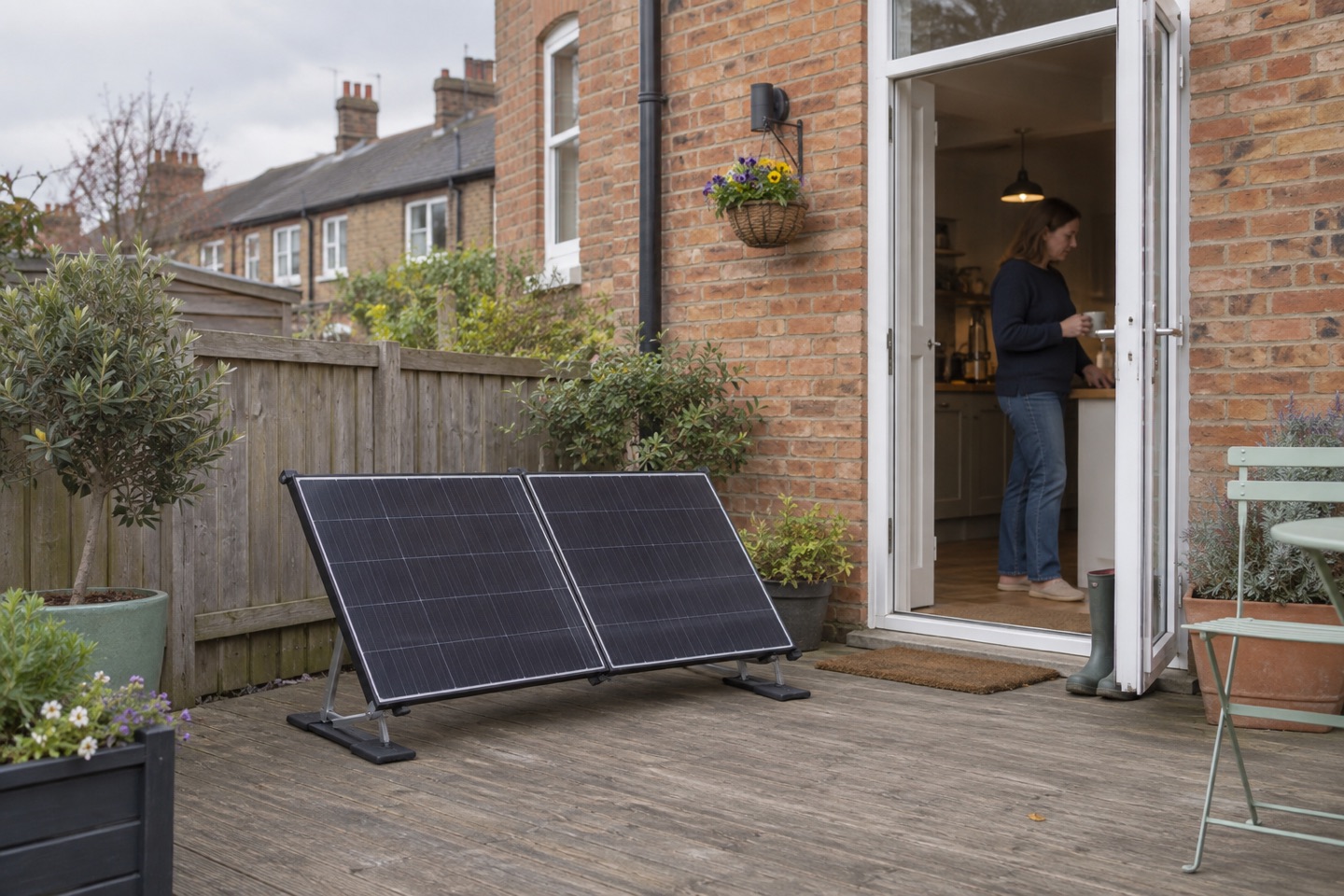
Renters cannot normally alter the roof. Grant applications are made by the property owner, and permanent installations need the freeholder’s consent.
Plug-in solar gives tenants a portable option.
Why it works when nothing else does
It plugs into a socket. There is no structural change, no electrician, no roof access, and nothing that outlives your tenancy. It behaves more like an appliance than a permanent installation.
Set expectations honestly
An 800 VA kit generates around 650 to 800 kWh a year. At typical unit rates that is roughly £175 to £215 off your bill annually, and only for electricity you are using while it is being generated: plug-in kits are not usually metered for export, so surplus is given away.
That may repay the kit in three to four years, but it will only cover a small share of most households’ electricity use.
Before you buy: three checks in your tenancy
- Alterations clause. A freestanding kit alters nothing. A wall-mounted or railing-clamped one might, depending on the wording.
- External appearance. Some tenancies and many leaseholds restrict what may be visible from the outside, particularly on balconies.
- Communal areas. A balcony is often demised to the flat; a shared walkway or roof terrace is not, and putting anything there needs the freeholder.
If you need to ask, ask in writing and describe it accurately: a plug-in appliance, freestanding, removable, no fixings, no electrical work. Most refusals in practice come from the word “solar” conjuring scaffolding and roof penetrations rather than from the actual object.
What to buy
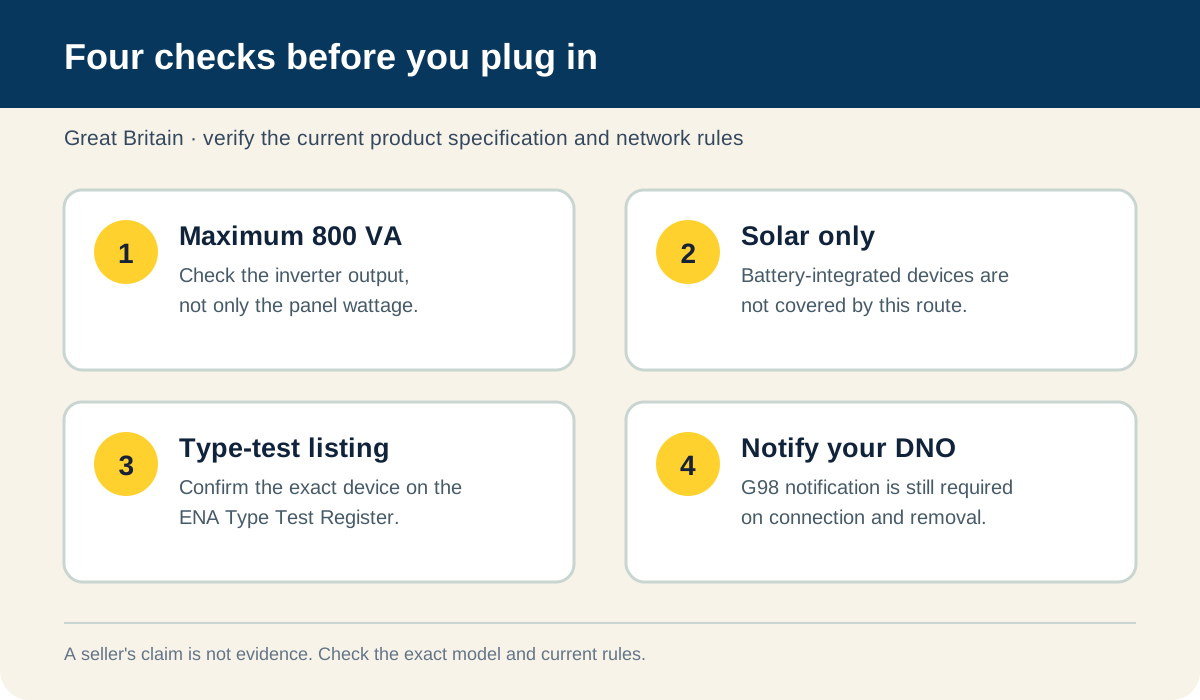
The same four conditions apply to you as to anyone else: see what is permitted. In short:
- inverter capped at 800 VA,
- no battery in the kit,
- the device listed on the ENA Type Test Register,
- one device per household.
For a rented property, add a fifth: buy a mounting that does not need to fix to the building. Ballasted floor stands and freestanding A-frames cost a little more than a railing clamp and remove the entire permission question.
Notify the network operator
Still required, still free, still ten minutes: how to send a G98 notification. Do it at your current address, and again if you move.
When you move
Take it. That is the advantage no landlord-installed system offers: the kit is yours, it is portable, and the three to four year payback means it will still be earning long after this tenancy ends.
Unplug, unmount, notify the operator at the new address, and let the old one know it has been removed.
What is not available to you, and why
It is worth being clear rather than leaving you to discover it:
- Grant funding. ECO4 and Warm Homes: Local Grant fund the building, and the owner applies. WH:LG can reach private rented property, but your landlord is the applicant.
- The Smart Export Guarantee. It requires an MCS-certified installation and an export meter. A plug-in kit has neither.
- The 0% VAT rate. That covers installed domestic systems, not plug-in appliances.
None of that is a reason to skip the kit. It is a reason to be sceptical of anyone who implies you can access those things through one.
Common questions
Do I need my landlord's permission?
What if my landlord objects anyway?
Can I take it with me when I move?
Is there any grant funding for this?
Will it noticeably cut my bill?
Sources
Checked 2026-09-02. Rates, rules and eligibility can change. Confirm current terms before signing a contract or applying for funding.