Open right now
Warm Homes: Local Grant
Not a government service. UKSolars is an independent company. It is not affiliated with, endorsed by or acting on behalf of the UK Government, DESNZ, Ofgem, MCS or any local authority. We do not administer any grant scheme, we cannot approve an application, and we never charge for anything a government provides free.
How we are paid. We are paid a fee by installers when we introduce a homeowner who asks for a quote. It does not change your price, and we are not paid more by one installer than another for the same job. In full.
Short answer
Warm Homes: Local Grant funds energy improvements for privately owned homes in England rated EPC D to G. You qualify on income by any ONE of three routes: living in an area within IMD income deciles 1–2 (no income check), meeting low-income proxies such as qualifying benefits, or a gross household income of £36,000 or less.
- Income routes
- Three: any one
- Income ceiling
- £36,000 or less
- EPC bands
- D to G
- Tenure
- Privately owned only
- May 2026 delivery
- 74 projects, 271 councils

Warm Homes: Local Grant supports low-income households in England. Availability and the application route vary by council.
DESNZ’s May 2026 release records 74 projects involving 271 local authorities, covering more than 97% of eligible English authorities. That is evidence of broad delivery, but it does not prove that every council is currently accepting new household applications.
What has to be true about the property
Three things, and all of them:
- In England. Scotland, Wales and Northern Ireland have their own schemes.
- Privately owned: by you, or by your landlord. Council and housing association homes go through the separate Warm Homes: Social Housing Fund instead.
- Rated EPC D to G. Look yours up free on the government EPC register; it takes about thirty seconds. Park homes, which typically have no EPC, are treated as an exception.
Three ways to qualify on income, not one
There are three income routes. The £36,000 threshold is only one of them.
You need to meet only one of these:
| Pathway | What it means | | --- | --- | | IMD income deciles 1–2 | Your area is among the most income-deprived nationally. No income verification needed at all. | | Low-income proxies | Qualifying benefits and similar indicators, verified by the local authority. | | Income threshold | Gross household income of £36,000 or less. |
Check your postcode before you check your payslip
The first pathway is the one people miss. If your area sits within IMD income deciles 1–2 you are income-eligible without proving anything about your earnings, which can matter a great deal to a household just over £36,000.
Your local authority can tell you which pathway applies to your address.
Why “am I eligible?” has no national answer
The scheme is administered by local authorities, and that is not an administrative detail — it is the defining feature.
Each authority appoints its own delivery partner, opens at its own time, and may layer LA Flex criteria on top of the national tests. The consequence is that two households with identical circumstances, twenty miles apart, can get different answers.
What no national page can tell you
Whether your council is running the scheme at all. Who the delivery partner is. Whether it is open to new applications today. What local criteria have been added. Every one of those is a phone call, and it is the phone call that decides your answer.
We only publish council pages after confirming the local scheme status, delivery partner and eligibility rules.
What it funds, and the ordering that surprises people
The assessment is whole-house. The property is surveyed and modelled, and funding goes to the measures that improve it most.
In practice that means insulation and heating come first. Solar is attached where the modelling supports it: often alongside a heat pump, where the two work together: rather than being the thing you request.
If your goal is specifically solar panels and your loft is uninsulated, expect the loft.
If you rent
- Private tenants. The property can be eligible, but your landlord is the applicant and usually has to contribute. Approaching them with the scheme named and the criteria attached is far more effective than asking whether they have considered solar.
- Council or housing association tenants. You cannot apply. Your landlord’s asset management or retrofit team is the route, and it is worth asking them whether the property is in their programme: naming Warm Homes: Local Grant specifically.
What to do
- Look up your EPC on the government register. If it is A to C, this scheme is not for you.
- Check all three income pathways, starting with whether your area is in IMD income deciles 1–2.
- Ring your council and ask three things: are you delivering WH:LG, who is your delivery partner, and is it open.
- Ask specifically about LA Flex if you narrowly fail the national test.
- Expect insulation or heating to lead, and treat solar as a possible part of the package.
The eligibility checker walks the national tests in your browser and shows which of the three routes may apply.
A note on timing
ECO4 closes on 31 December 2026 and the wider Warm Homes Plan is already delivering, with WH:LG and the Social Housing Fund due to be integrated into a single low-income scheme from 2027/28. WH:LG runs through that transition, but local budgets are finite and authorities close when their allocation is committed rather than on a national date.
If you qualify, apply. Waiting for a better scheme is how people end up with neither.
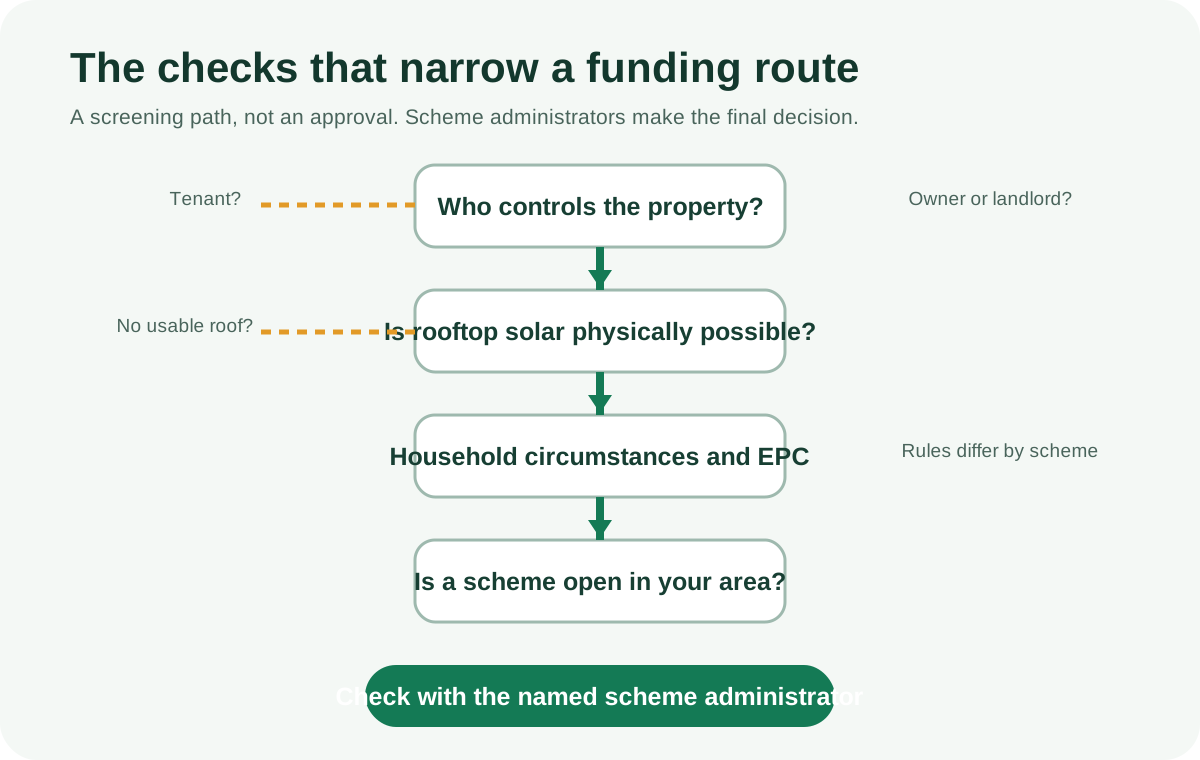
The process, step by step
Check the national tests
The property must be in England, privately owned, and rated EPC D to G. Then you need to meet just one of the three income pathways. Both parts have to hold before anything local matters.
Find out whether your council is running it
This is the step no national page can do for you. Not every authority is delivering the scheme, and those that are opened at different times with different local criteria.
Identify the delivery partner
Applications are rarely taken by the council itself. Most authorities appoint a managing agent or installer consortium to assess applications.
Assessment and survey
The property is assessed on a whole-house basis. Expect insulation and heating to be considered before solar, because that is how the funding is modelled.
Installation
Carried out by the partner's contractors. You do not choose the installer, which is the main trade-off against paying for the work yourself.
Common questions
Is Warm Homes: Local Grant the same as the Warm Homes Plan?
Does it pay for solar panels?
Can I get it if I rent?
What if my council is not running it?
What if I am just over £36,000?
Sources
- gov.uk: Apply for the Warm Homes: Local Grant
- DESNZ: Warm Homes Plan
- gov.uk: Find an energy certificate (EPC register)
- DESNZ: Warm Homes: Local Grant statistics, May 2026
Checked 2026-09-02. Rates, rules and eligibility can change. Confirm current terms before signing a contract or applying for funding.
Check whether you qualify
Answer six questions and see the result on screen. No email required.
Get grant updates
We will email you when a scheme, threshold or deadline changes.