Is it worth it, and what will it cost?
How many solar panels do you actually need?
Short answer
There is no reliable panel count based only on bedrooms. Start with your annual electricity use, then check panel wattage, roof layout and the proportion of generation you can use or store. Divide the proposed system capacity in watts by the wattage of one panel to check the installer’s panel count.
- Start with
- Annual use in kWh
- Check separately
- System size in kWp
- Roof limits
- Edges, shade and obstructions
- Do not size by
- Bedroom count alone
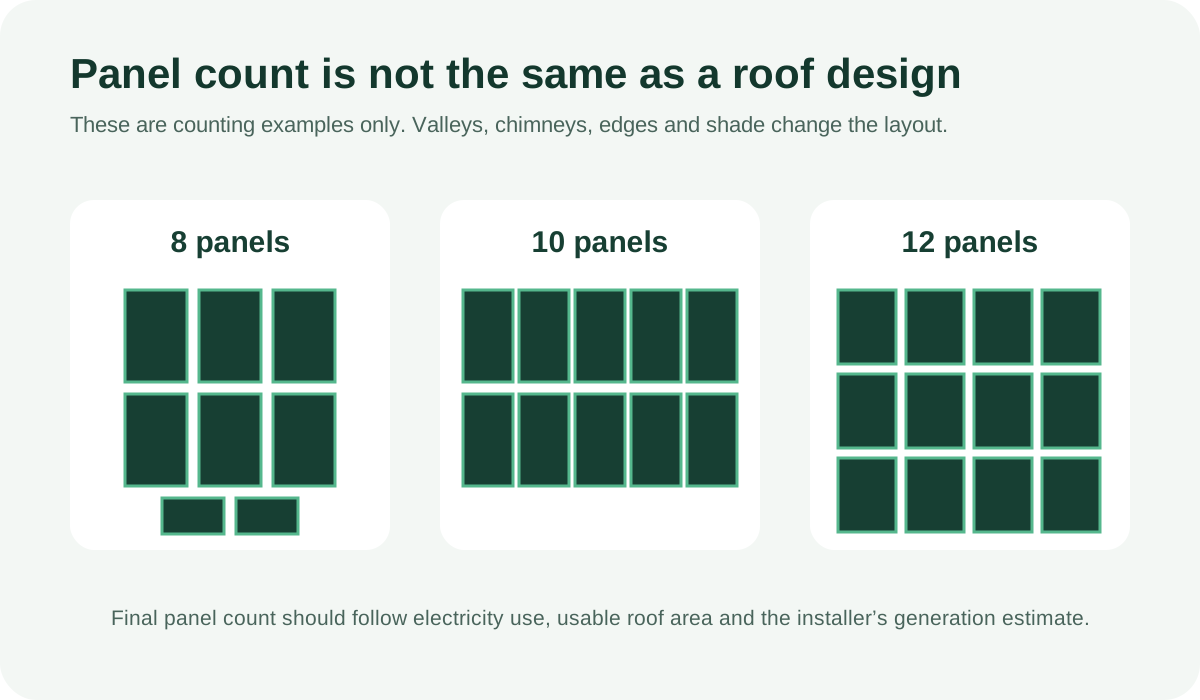
An installer may describe a system as “ten panels”, but the useful number is its capacity in kilowatt peak (kWp). Panel ratings change over time, so the same system capacity may use fewer higher-rated panels.
Work from your bill, not your bedroom count
Find the annual kWh figure on your electricity statement. Then note any planned change: an electric car, heat pump, home working or children leaving home can alter the right size.
The installer should estimate annual generation for the actual roof. Direction, pitch and shade matter, so system capacity and annual generation are not interchangeable.
Check the panel count yourself
Use this simple check:
Proposed system watts ÷ one panel’s watt rating = panel count
For example, a 4,400-watt proposal using 440-watt panels contains ten panels. This checks the arithmetic, not whether 4.4kWp is the right size for the home.
Roof space changes the answer
Chimneys, roof windows, valleys, hips and shaded sections reduce usable area. Installers also need safe edge zones and a fixing layout suitable for the roof. A neat rectangle drawn over a satellite image is not a structural survey.
Bigger is not automatically better
Additional panels can be good value because much of the installation cost is already fixed. But ask where their generation goes. If it will mostly be exported, compare the export income with the added cost rather than valuing every unit at your import price.
Allow for future electricity use
Tell the installer about an expected EV or heat pump. Do not add an arbitrary number of panels: ask for a second proposal showing the larger load, expected generation and likely self-use.
Next, check whether your roof is suitable and use the cost calculator to compare sizes using the same assumptions.
Common questions
How many solar panels does a three-bedroom house need?
What is the difference between kW and kWh?
Should I fill every available part of the roof?
Sources
- MCS: certified solar installation and performance standards
- Energy Saving Trust: solar panels guidance
Checked 2026-09-09. Rates, rules and eligibility can change. Confirm current terms before signing a contract or applying for funding.
What will solar cost you, and when does it pay back?
Set your roof size, your bill, your tariff and your export rate, and see the install cost, annual saving and payback year — with every assumption visible and editable. Runs in your browser; nothing is sent anywhere.
Get important solar updates
One email when a grant, export rate or rule changes. No newsletters or sales emails.